Most of what you hear from a fridge freezer is the machine doing its job: a low compressor hum, the soft whir of fans, refrigerant gurgling through tubing, a hiss during defrost and the clatter of ice landing in the bin. The sounds worth acting on are different in kind. A scrape or chirp that gets louder when the freezer door shuts, a compressor that clicks on and off every few minutes, or any new noise that shows up alongside soft ice cream is a fault. Here is each sound on a Sub-Zero built-in, what it usually means and what you can safely check.
Sounds a healthy unit makes
A built-in runs its compressor in long, even stretches, so a steady low hum is normal, as is a brief shudder when it stops. Refrigerant settling in the lines can trickle for a minute after each cycle. During defrost, water dripping onto the heater may sizzle, and liners tick as they warm and cool.
The ice maker adds its own pattern: a few seconds of buzzing while the water valve refills the mold, then a thud as cubes drop. If someone has turned on Max ice on a Classic (CL), Designer (DET, DEC) or PRO Series unit, expect a busier rhythm for a day. That setting lifts ice output by as much as 30% across 24 hours, so a few components work harder, and louder, until it times out.
Fan noises are the usual culprit
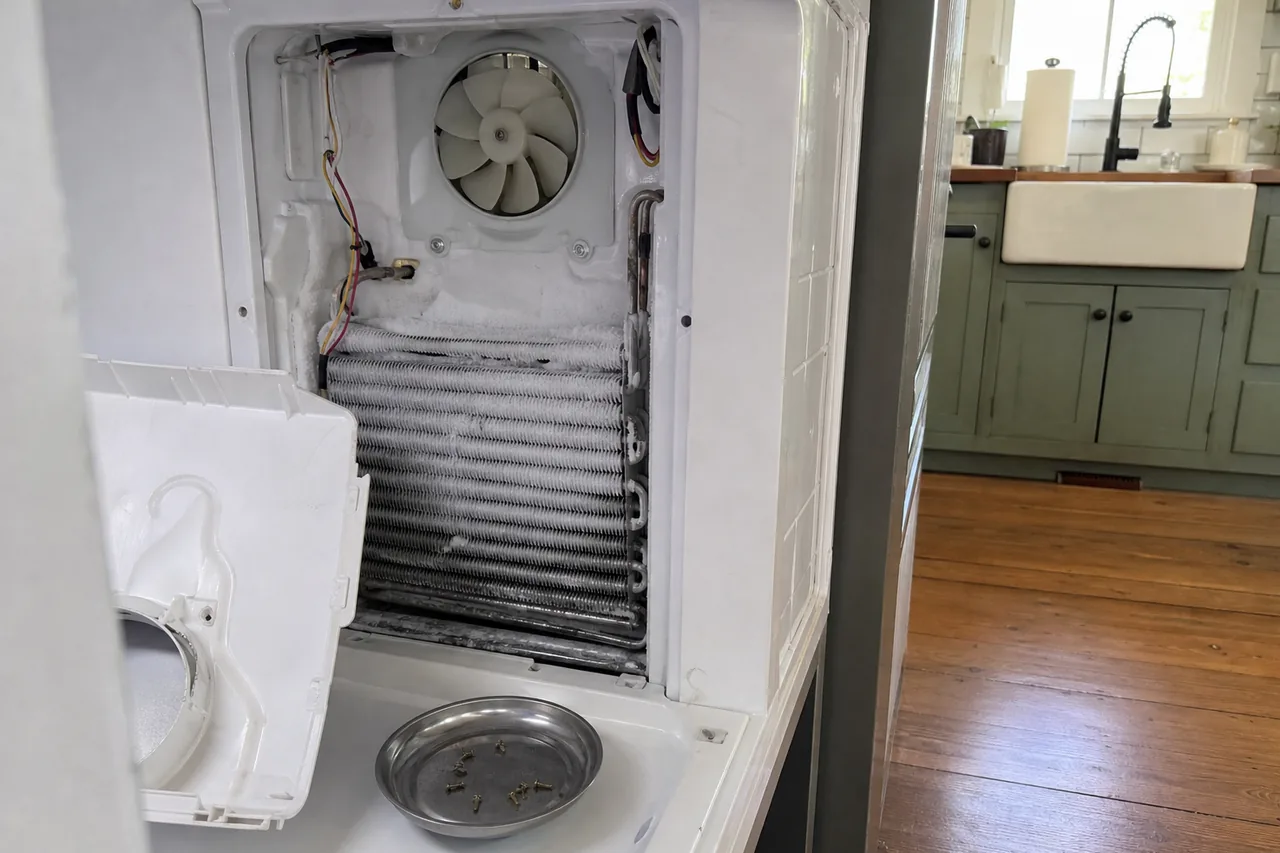
The evaporator fan lives behind the rear panel inside the freezer and draws air across the frosted coil; the condenser fan sits in the machine compartment. A tired fan motor bearing squeals or chirps, often loudest right after a door closes. Ticking or scraping inside the freezer usually means ice has grown into the blades, which points to a defrost problem or a door that is not sealing.
How to clear thick ice varies from one product line to the next. On Classic (CL) and Designer (DET, DEC) units, the instructions say to power down first, then thaw the buildup with a hair dryer set to low and never held still in one spot. The PRO Series guide calls for a handheld steamer and rules the hair dryer out. If frost returns within days, the defrost heater, thermostat or a sensor needs testing.
Compressor hum and long run times
A compressor that never rests, or one that clicks on, runs a few seconds and clicks off, is struggling to get rid of heat. On 600, 648PRO and 700 Series units the control may log EC40 with Service flashing, which Sub-Zero ties to excessive freezer compressor running, a door left ajar, or a fault in the sealed system, a fan or a temperature sensor. If the box is less than 10° above its setting, clean the condenser first. If it is more than 10° above and no door was left open, schedule service, and do not clear the code while temperatures keep climbing.
Ice maker and water valve noises
A long buzz or hammering at the valve suggests a weak valve or low supply pressure. On a Classic (BI), a single ice cube icon flashing with no alarm means the valve stayed open too long, so the control shut the ice maker down to prevent a flood. Confirm the household shutoff feeding the unit is fully open and the line is not kinked, then hold Alarm until CFC appears. If the ice maker has gone quiet altogether, check that Sabbath Mode is off: it disables the ice system and door alarm, and it comes back on by itself after a power cut.
Checks worth doing first
Switch the unit off at its control panel before reaching behind any grille. On a Classic (CL) the condenser sits behind the flip-up grille; on a Designer (DET, DEC) it is behind the kickplate, held by two screws. Wear gloves and vacuum it with a soft brush along the fins. A matted condenser makes fan and compressor work louder, and beach homes clog faster; see salt air and the condenser. Also check that each door closes firmly against its gasket.
When a noise needs a technician
Book a visit when a sound arrives with rising temperatures, when a fan keeps icing over, or when grinding persists after cleaning. Riverbend is an independent service using genuine OEM parts, and the diagnostic is $80. Typical ranges are $270–$580 for an evaporator or condenser fan motor and $900–$2,340 for compressor or sealed-system work, with the firm figure given after diagnosis. If the freezer is already warming, read about a refrigerator not cooling meanwhile.