The floor in front of the cabinet had been warm for months and I had assumed that was normal. The coil was thick with dust and animal hair. He cleared it and rechecked what the fan was pulling.
Georgette L.2026-07-17
Independent Sub-Zero refrigeration specialists
Jacksonville, FL Monday to Friday 8:00am – 6:00pm Saturday 9:00am – 4:00pm
condenser and airflow
The maintenance job that prevents most sealed-system failures, and the local reasons it comes due sooner here.
Symptoms this sheet covers
General note 1 — scope of work
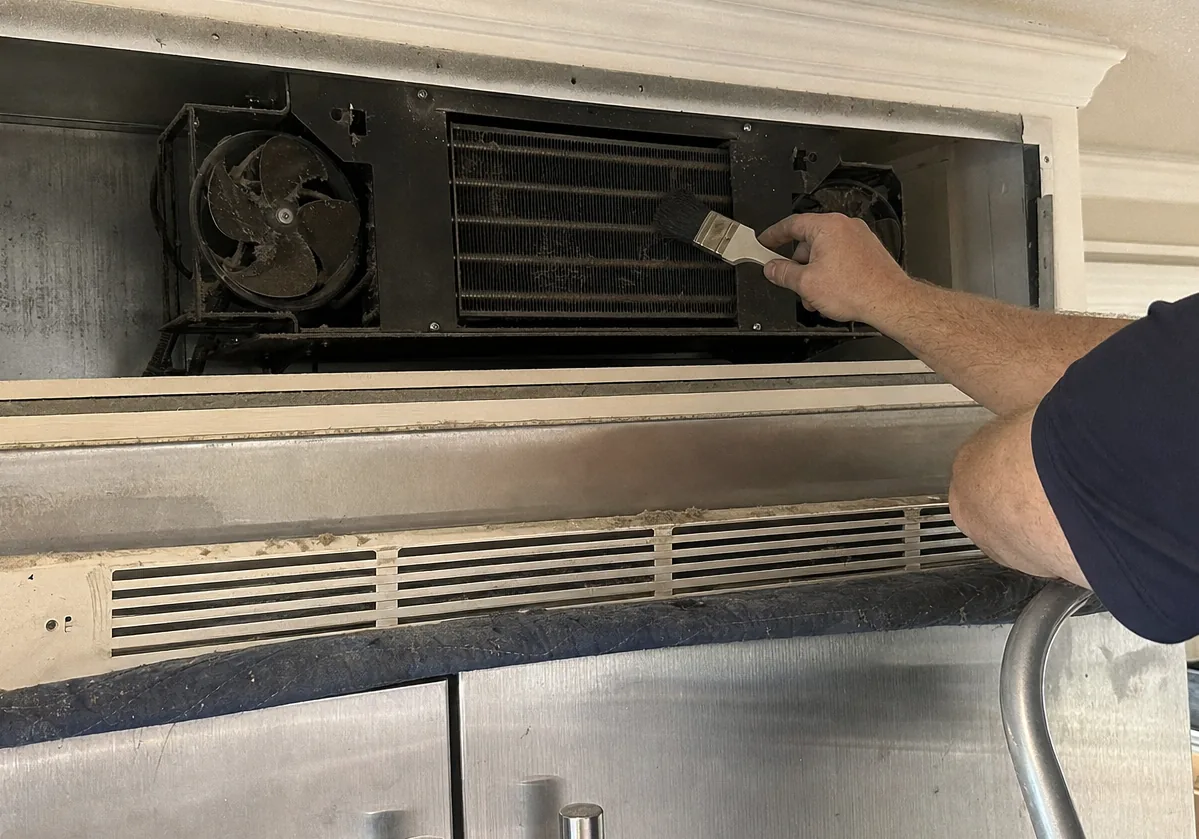
Condenser cleaning is the least glamorous item on this site and the one that prevents the most expensive failure on it. A condenser rejects the heat the compressor moves out of the cabinet. Insulate it with a mat of dust and it cannot, head pressure climbs, the compressor works against itself, and the cabinet slowly loses the ability to hold temperature on a hot afternoon.
Three local loads land on the same coil.
Pollen. North Florida runs a long pollen season, and it arrives as a fine powder that bonds to a slightly oily coil surface. A cabinet cleaned in November can be visibly loaded again by April.
Humidity. Dust on a dry coil is loose. Dust in a kitchen that spends six months near saturation becomes a felt, and a vacuum alone will not lift it.
Salt air on the coastal ZIPs. Within a few blocks of the ocean in 32250 and 32233, the aluminum fins carry a salt film that holds moisture against the metal. That is corrosion, not just fouling, and once fins begin to powder the coil loses surface area permanently.
Inland, twice a year is a reasonable interval. Within sight of the water, or in a house with two shedding dogs, we usually recommend three times.
Read the operating condition first. Discharge air temperature at the grille and both compartment temperatures, taken before anything is touched, so the before-and-after is a measurement rather than an impression.
Remove the grille and vacuum the coil face. The upper grille on a built-in is the intake and exhaust for the whole machine. It gets pulled, cleaned and inspected for a bent louver that is throttling the airflow.
Brush the fin pack in the direction of the fins. Cross-brushing bends fins flat and does more harm than the dust did. This is a hand job with the right brush, not a shop vac waved at the front.
Check the condenser fan. Blade condition, bearing noise, and whether the shroud is seated. A fan that runs but is missing its shroud moves air past the coil rather than through it.
Confirm clearance above the cabinet. A built-in needs an open path from the grille out of the cabinetry. Retrofits in older kitchens often have a decorative panel or a crown moulding that has quietly sealed the exhaust route.
Re-read discharge and compartment temperatures. You get both sets of numbers. On a badly loaded coil the discharge temperature typically drops noticeably and the compressor starts cycling again within the hour.
If the coil is clean and the cabinet still runs long, the problem is elsewhere, and we say so rather than selling a maintenance visit that will not fix anything. The usual next suspects are a failing condenser fan, a door seal loading the box with humid air, or a genuine sealed-system fault.
If the fins are corroded through — which we do see on beach-front installations that were never serviced — cleaning recovers very little. The coil has lost metal, and the honest recommendation is a condenser replacement or, depending on the age of the cabinet, a conversation about the machine as a whole.
Condenser service is quoted before we start. If we find a second fault during the visit, it goes on a written estimate and nothing is ordered until you approve the number. The diagnostic fee is flat and credited toward any repair you authorise.
We are independent, we service Sub-Zero refrigeration only, and every part we fit is genuine OEM with 365 days of parts coverage and 90 days on the labor.
One number is known before the van moves: $80 to read the cabinet, credited against the work if you approve it. Everything scheduled beneath it is a band and not a figure, because the part sets the number and the part is not named until the readings are in.
| Item | Band |
|---|---|
| Reading the cabinet, diagnostic sequence | $80 flat |
| Evaporator or condenser fan motor | $270–$580 |
$80 buys the readings; $580 is the ceiling of everything scheduled above it. The written estimate sits between the two and carries one figure, handed over before a part is ordered.
Asked and answered
Book the diagnostic
Flat diagnostic fee, credited in full toward the repair if you approve the work. Written estimate before any part is ordered or any labor is billed. See the pricing sheet for how the fee works and the warranty sheet for what the finished repair carries.
Call +1 (904) 977-87014.5 out of 5 across 71 customer reviews. Read every one of them.
The floor in front of the cabinet had been warm for months and I had assumed that was normal. The coil was thick with dust and animal hair. He cleared it and rechecked what the fan was pulling.
Georgette L.2026-07-17
Cleaning was done thoroughly and the cabinet settled within the day. He also pointed out a bent grille clip from a previous visit by someone else and straightened it while he was down there.
Emory Z.2026-06-13
The unit was boxed in so tightly that the warm air had nowhere to go. He measured the space, showed me where the return path was blocked and opened the base panel route rather than selling parts.
Julius E.2026-01-29