Condensation on the inside of the glass every afternoon without fail. He measured the room as well as the cabinet, and was straight with me that the west wall was half of the problem.
Ambrose W.2026-03-02
Independent Sub-Zero refrigeration specialists
Jacksonville, FL Monday to Friday 8:00am – 6:00pm Saturday 9:00am – 4:00pm
Duval County / 32250
The one part of the county where a refrigerator condenser loses metal rather than airflow, and cleaning stops working.
What governs a call here
Salt air
Within a few blocks of the ocean the condenser loses metal rather than airflow, so a cleaning stops being the answer and the hardware around the coil is inspected on every visit.
General note 1 — what we are called to in Jacksonville Beach
Communities Jacksonville Beach · South Jacksonville Beach · Isle of Palms
Everywhere else in Duval, a condenser that is not performing has lost airflow. Remove the mat of dust and pollen and it works as designed again. Within a few blocks of the ocean that stops being true, and the difference decides whether a cleaning is worth doing at all.
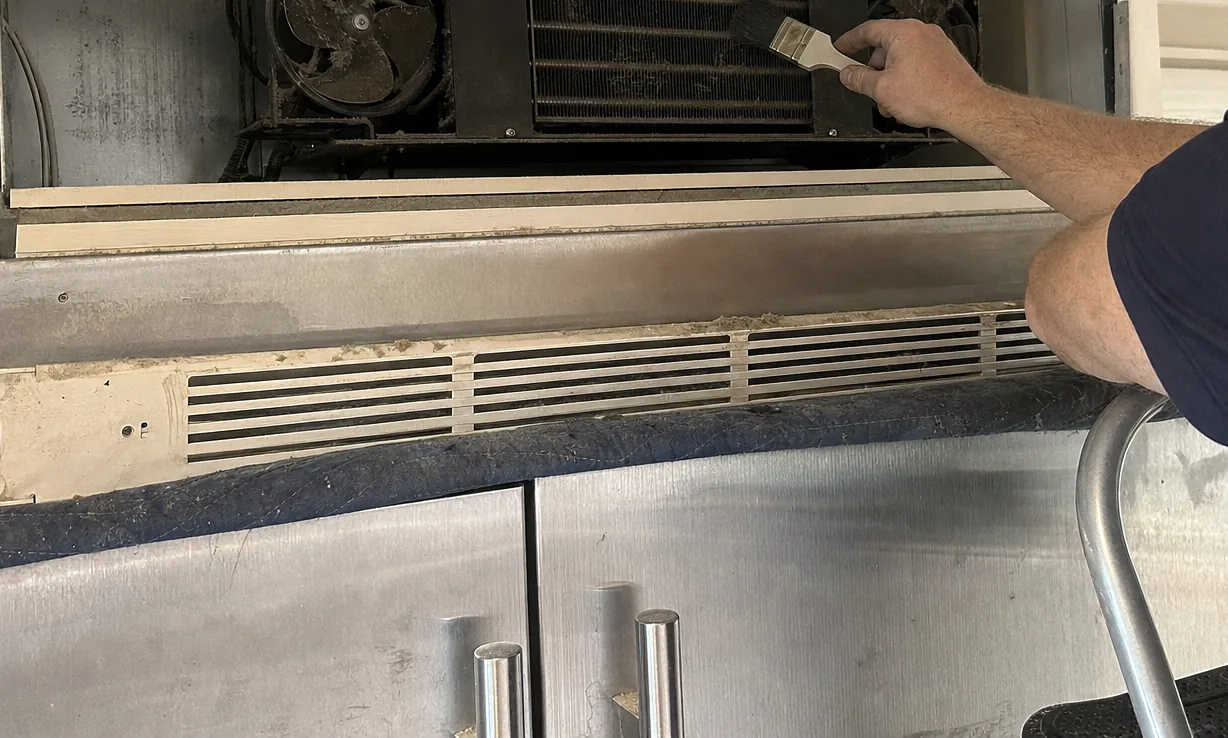
A built-in rejects heat through a condenser behind the upper grille, and that grille is an intake. In 32250 the air moving across those fins carries salt aerosol.
Salt film is hygroscopic. It pulls moisture out of humid air and holds a film of salt solution against aluminum between rain events, which in a North Florida summer means essentially continuously. Aluminum protects itself with an oxide layer, that layer holds up poorly against chloride, and because fin stock is thin to begin with it does not take long for local pitting to become a hole. Fins thin, powder, and in places detach from the tube. Surface area is gone permanently and no amount of brushing brings it back.
The second mechanism is galvanic. A condenser assembly puts aluminum fins in contact with copper tube and steel fasteners; add a conductive salt film and you have a cell, and the aluminum is the sacrificial half. That is why corrosion appears at the junctions first — fastener heads, the fan shroud mounting, the bracket where the coil is supported.
Fin condition under a light. Bright, straight fins with intact edges are fouled at worst, and cleaning restores them. Dull grey fins with a chalky surface, or fins that crumble under a soft brush, are corroded, and the recommendation changes from “clean it” to “replace it or plan for the cabinet”.
The junctions. Fasteners, shroud mounting and coil brackets, because that is where the galvanic cell sits.
Condenser fan hardware. Bearings and mounting hardware here go before the motor itself does, which is not the order they fail in inland.
Hinges and closers. The same air works on hinge pins. Play at the pin lets the door hang slightly out of parallel, the gasket loses contact along one edge, and in a humid coastal kitchen the first complaint is condensation on the frame rather than anything that sounds like corrosion.
Where the grille draws from. A cabinet whose intake sits in a covered lanai or a breezeway can be pulling concentrated salt spray. Changing that airflow path is far cheaper than replacing a condenser twice.
The stainless. Tea-coloured staining on a beach-house door is airborne chloride sitting on the passive layer. It is cosmetic while it is on the flat panel and it stops being cosmetic when it reaches a weld seam or a fastener.
Undercounter cabinets in a beach-house summer kitchen are the shortest-lived refrigeration on the island, and the reason is not only the air. A refrigeration cabinet rejects heat into the space around it, and ambient temperature in an outdoor run through August is far above anything a kitchen cabinet sees. Duty cycles lengthen, the condenser loads faster, and the machine has less margin before a marginal component shows itself.
A cabinet not rated for outdoor installation will not last there. Where one has been fitted anyway, we will say so plainly rather than repeat the same repair annually, because the location is the fault and no repair addresses it.
A corroded condenser assembly is not a stocked-on-the-van part, and neither is a fan assembly on an older platform. Two things follow that are worth knowing before you approve an estimate.
The first is the serial number. Built-in refrigeration is produced in long-lived platforms with running changes, and components are frequently specific to a serial range rather than to the model as a whole. The plate is inside the fresh-food compartment on the upper left side wall. Ordering against the model alone is how the wrong part arrives and a repair loses a week.
The second is that we tell you the date we were given, and we tell you again when it moves. Where a component has been superseded or is no longer stocked, that goes on the estimate before you approve it, not after — because on a corroded machine it frequently changes the decision from repair to replace, and that decision belongs to you with the facts in hand.
Three condenser services a year rather than two within sight of the water, and a hardware inspection on every visit — hinge pins, fan mounting, and the condition of the fin pack. Rinsing the grille area with fresh water helps where the kitchen allows it.
What we will not tell you is that any of this makes a coastal installation last as long as an inland one. It does not. What it does is push a condenser replacement well beyond where it would otherwise land, which on a built-in is worth a great deal.
Flat diagnostic fee, credited toward the repair. Written estimate first. We are independent, we service Sub-Zero refrigeration only, and parts are genuine OEM with 365 days of coverage.
One number is known before the van moves: $80 to read the cabinet, credited against the work if you approve it. Everything scheduled beneath it is a band and not a figure, because the part sets the number and the part is not named until the readings are in.
| Item | Band |
|---|---|
| Reading the cabinet, diagnostic sequence | $80 flat |
| Compressor or sealed-system repair | $900–$2,340 |
| Evaporator or condenser fan motor | $270–$580 |
$80 buys the readings; $2,340 is the ceiling of everything scheduled above it. The written estimate sits between the two and carries one figure, handed over before a part is ordered.
Asked and answered
Sealed system last. Every reading written down and handed over.
Book a visit in Jacksonville Beach
Flat diagnostic fee, credited in full toward the repair if you approve the work. Written estimate before any part is ordered or any labor is billed. The full terms are on the pricing sheet.
Call +1 (904) 977-87014.5 out of 5 across 71 customer reviews. Read every one of them.
Condensation on the inside of the glass every afternoon without fail. He measured the room as well as the cabinet, and was straight with me that the west wall was half of the problem.
Ambrose W.2026-03-02
Two blocks from the water and the fin stock had corroded at one end. He was blunt that cleaning would not restore it and priced the coil work rather than letting me pay twice to find out.
Bartholomew A.2026-03-21
The seal work was done properly and the sweating stopped. What I did not like was being told a part was in stock when it was not, and finding that out on the day of the second visit.
Mortimer A.2025-11-19